
Detention centres
Russian forces took control of various buildings, including Ukrainian government facilities.
In particular, a scheme of organisational relations of the occupation authorities was established under the leadership of Lieutenant Colonel Buslov V. O. (“Granite”), who was located in the premises of the former Balakliiskyi District Prosecutor's Office.
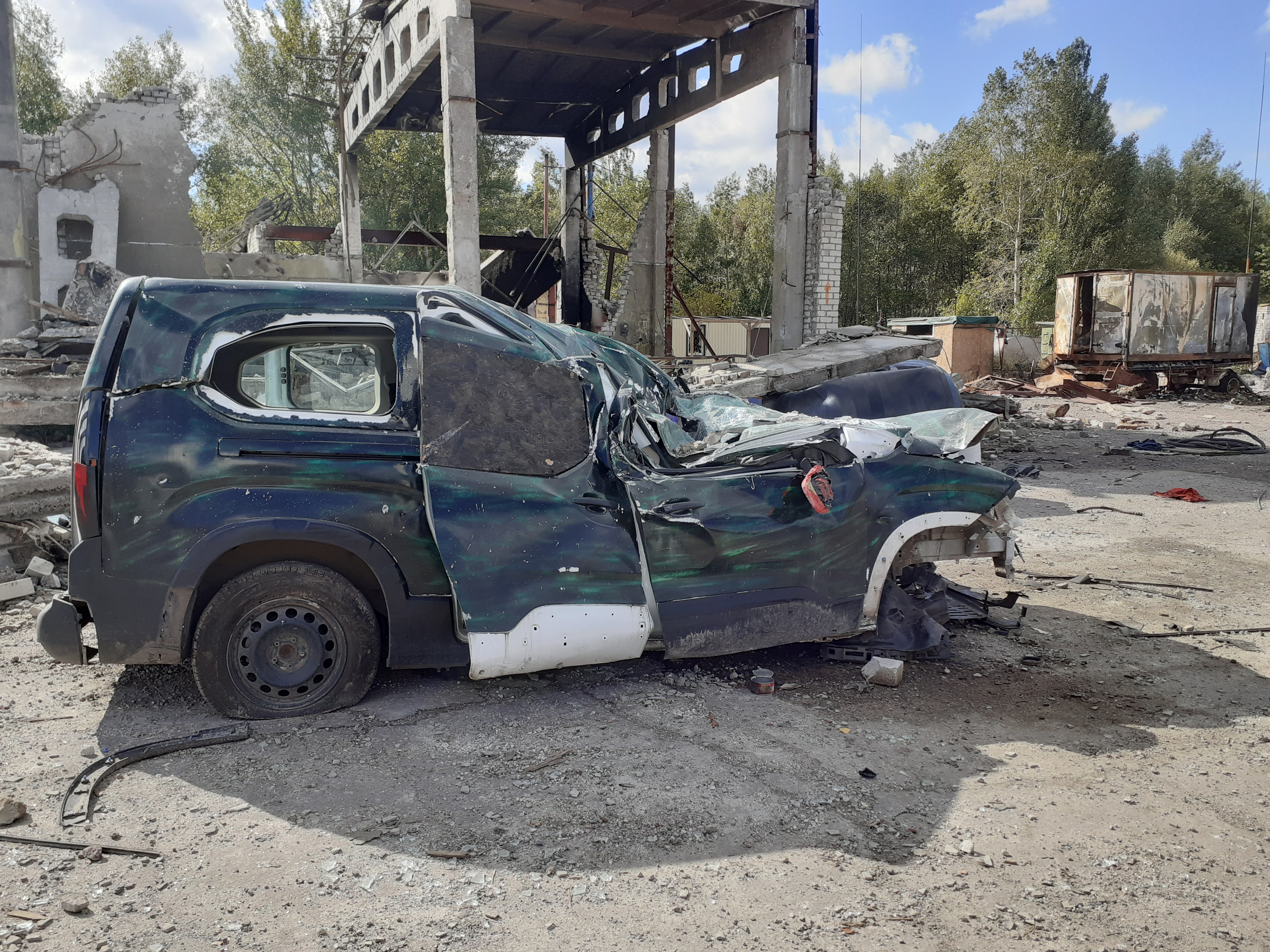
The buildings were repurposed as military bases and used for the detention and torture of captured civilians. The repurposed buildings included schools, a car park (“Autopark”), basements, police stations, and prosecution offices.
Basement on the territory of the 'new' car park where civilians were held, Balakliia, April 3–10, 2022. Photo: Truth Hounds
A place of detention of civilians and a torture chamber on the territory of the new ATP (“Autopark”).
One such building was the BalDruk publishing house (coordinates 49.452285 and 36.842880) located opposite the police station, near the monument of the national poet Taras Shevchenko (1814-1862). Russian forces established a base within the building and used it as a detention centre. The repurposed building was called “the commandant’s office”, and approximately 40 prisoners were detained there at all times. Detainees were tortured in its basement.
The Russian Commandant's Office, a place of detention of civilians and a torture chamber in the premises of the “BalDruk” publishing house.
One of the infamous detention centres, described in this report, was the Balakliia police station, located across the street, also occupied by the Russian troops. Reports from residents and investigators indicate that the building was extensively used for detention and torture. According to a victim, arbitrarily detained residents were held in detention cells in the basement.
A similar pattern was observed in the village of Verbivka, where Russian forces seized key buildings, including the local school and the village council. These sites were not only used as operational bases but also repurposed as detention and torture centres.
LPR headquarters in the village council building of Verbivka.
The Balakliia police station, or ROVD, was at 33 Zhovtneva Street (coordinates 49.4522624 and 36.8431992). It served as the central place of internment. Detainees, including men and women, were brought from Balakliia and neighbouring settlements, such as Verbivka, Neftianykiv, and Savyntsi. The station was staffed mainly by officers from the self-proclaimed Luhansk and Donetsk People’s Republics, Chechnya, and Federal Security Service (FSB) officers. Russian soldiers also resided at the station.
Individuals were typically brought to the station with bags over their heads. The practice was referred to as “the invisible hat” by the station’s personnel. Many detainees recalled being forced to wear a bag over their heads and pushed into a vehicle during their arrest. The car used to transport victims to the station, often described as a military “Tigr” (Tiger), drove for extended periods around the town before stopping near the building. Survivors believed this was a tactic to disorient them, preventing them from identifying the locations where they were held. One of them recalled that before he was taken to the police station, soldiers conducted a search of his house, pressured him to confess, beat him with truncheons and inflicted cuts on his ear.
Detainees were held at the station for varying periods, lasting from a few days to several months. Some victims were released by station personnel; others were held until Ukrainian forces liberated the town. Others disappeared without a trace. Several victims testified that they were taken from the detention centres to the checkpoint located at Henkel (325 Peremohy street, in Balakliia) and then “deported” to the area controlled by Ukraine via the checkpoint at the cement plant (coordinates 49.492288 and 36.753728). According to these testimonies, before being allowed to cross to the Ukrainian-controlled territory, they were forced to record videos in which they had to discredit the Ukrainian military and provide false statements about their opinions. These videos were likely created for Russian propaganda purposes, aiming to manipulate public perception and undermine support for Ukraine’s military forces.
The police station continued to operate as a detention site until the Ukrainian army fully liberated the town. When Russian officers fled, a detainee found a crowbar and used it to unlock the cells. Upon leaving their cells, the detainees discovered a room where their documents had been stored. One of the victims found his documents in a bag labelled with his name.
The station served as a site for interrogations, which involved measures amounting to torture according to international law, i.e., officials inflicting severe physical and psychological pain to extract information or punish the detainees. The Balakliia police station is particularly notable for the severity of the violations inflicted on detainees, including by FSB officers.
Subsequent sections of this report will emphasise key findings, excerpts from interviews, and statements detailing the conditions and treatment within the detention facility.