
Arbitrary Detention
Individuals who remained in Balakliia during the occupation faced numerous violations of international humanitarian law, including arbitrary detention, inhuman and degrading treatment, torture, rape, enforced disappearances and extrajudicial killings at the hands of the occupying forces.
Arbitrary detention was widespread. It refers to depriving a person of liberty without their free consent, legal justification, or due process. Both international human rights law and humanitarian law prohibit arbitrary detention, which is a fundamental principle aimed at ensuring the humane treatment of individuals during armed conflicts.
Torture centres discovered in and around the town, as well as a mass grave in the city of Izium, suggest egregious violations in the treatment of the population.
The Russian troops conducted mass searches of homes and private properties, often followed by the detention of residents. The primary targets remained those suspected of “collaborating” with Ukrainian forces. According to numerous testimonies, the occupying troops targeted local politicians, current or former members of the Anti-Terrorist Operation or Ukrainian Armed Forces, their close family members, state employees, and ordinary citizens suspected of supporting Ukraine. These actions created an atmosphere of fear and oppression within the occupied territories.
At the start of the invasion, when the internet was still accessible, some individuals filmed Russian soldiers or military equipment in the town and posted these videos on social media without turning off their geolocation. A week or two later, they would be visited at home. Their phones would be confiscated, and they could be “thrown into the pit”, which referred to the basement of the police station, where mistreatment of detainees took place.
The occupying power appeared well-informed about pro-Ukrainian citizens, particularly those who had previously served in the Donbas war. One survivor explained that the Russian military likely had access to specific information about the local population even before the occupation. This included details such as residents’ addresses, their financial status, whether they had served in the military, and their support for Ukraine.
In some cases, residents referred to as “collaborators” informed Russian troops about targets and their whereabouts. The collaborators worked with the occupying forces and regularly provided information about their fellow citizens. Collaborators could be anyone, including neighbours, colleagues, or even family members.
Based on interviews with survivors, a consistent pattern has emerged regarding the methods of arrest. Arrests were not confined to specific locations; they could occur anywhere, including temporary checkpoints and private homes. Individuals could be arrested in the street, at a market, in a park, or any other public place.
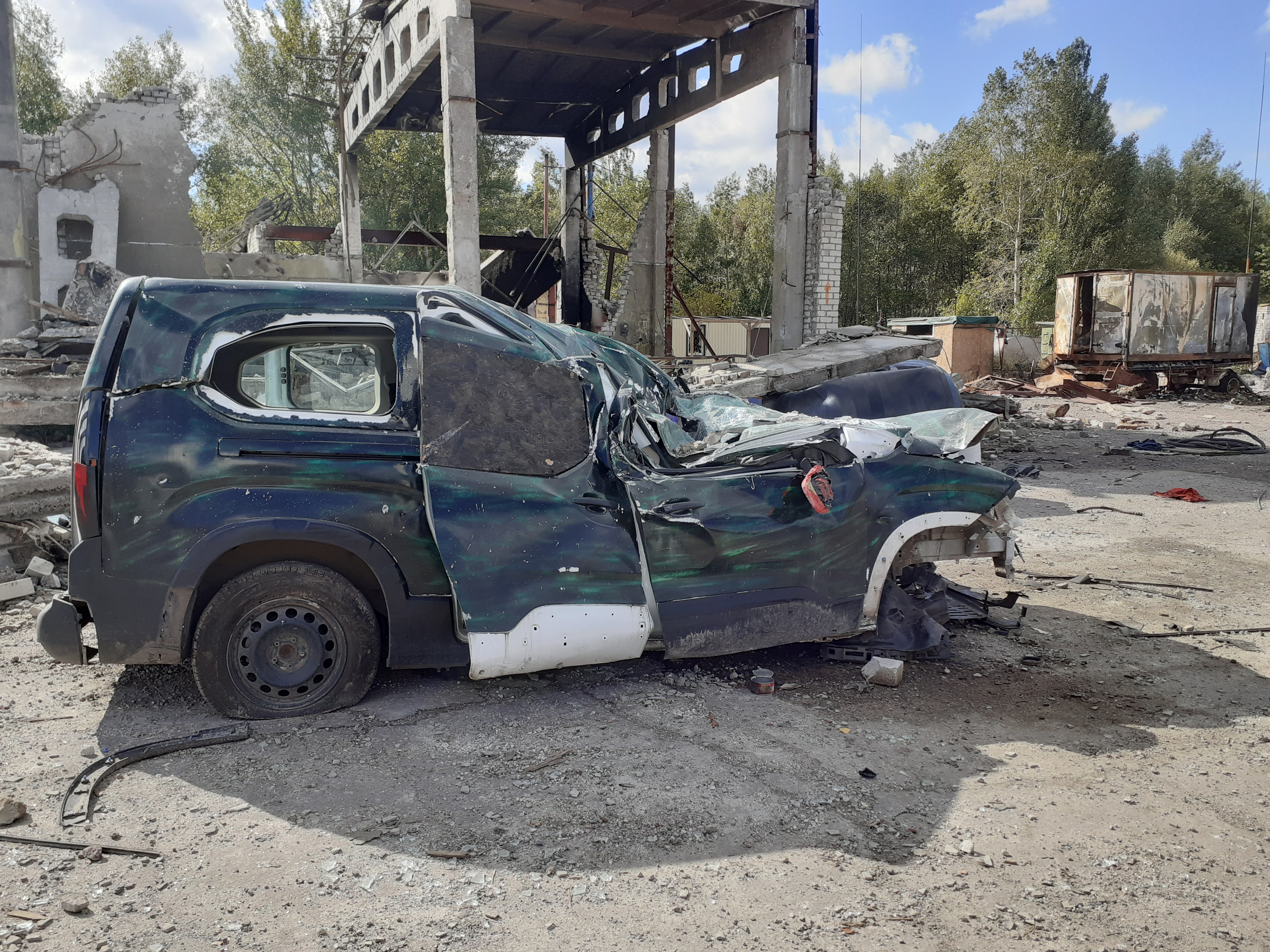
Entrance to the basement on the territory of the car park, where detainees were held, Balakliia, April 3–10, 2022. Photo Credit: Truth Hounds.
Some victims were arrested and held at detention centres due to their sons’ service in the Ukrainian military. For instance, a testimony recounts the story of a man whose house was searched and who was subsequently detained after Russian forces discovered his son’s uniform, which indicated his service with the General Staff of Ukraine.
Survivors also described how a married couple were detained after the Russian military discovered a Ukrainian flag at their premises during searches of their house. Another survivor was detained after he talked negatively about and cursed Putin while Russian soldiers were checking his documents.
One of the survivors recalled that during his arrest, Russian soldiers did not explain the reason for the arrest, put a dark bag on his head, wrapped his hands with tape, shoved him into a car and asked: “Do you love Ukraine?” They then punched him in the chest.
Geneva Convention IV allows for the internment of civilians only if it is absolutely necessary from a military point of view. It can never be used as a form of punishment. The analysed information does not provide grounds to assume that the detentions were in line with the principles of international humanitarian law.