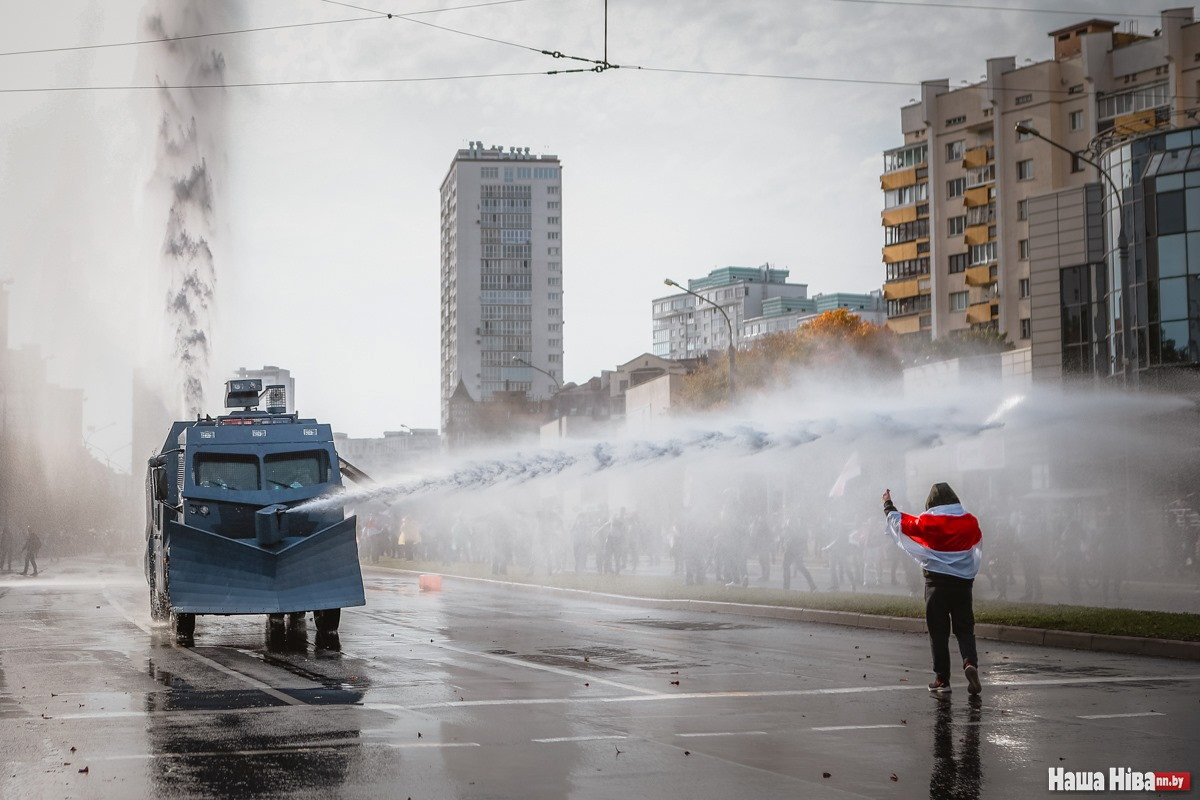

Unexpected mass mobilization
The Eurasia Section
The NHC is proud of its longstanding support to civil society, documentation of human rights abuses and advocacy in the entire post-Soviet space.
In Central Asia, the NHC has played a unique role since its representative office was opened 15 years ago. The region contains some of the most authoritarian regimes in the world, and all five countries face serious human rights challenges in some shape or form. The NHC conveys knowledge about the situation, support local human rights groups and serve as a bridge between events on the ground and important international institutions.
Two years ago, the NHC published a report on so-called frozen conflicts. In 2020, one of these conflicts, the decades-old conflict between Armenia and Azerbaijan over Nagorno-Karabakh, erupted fully fledged in August. Several intense weeks of bloody war left thousands of dead. The war resulted in Azerbaijan re-taking territories occupied by Armenia more than twenty years ago, taking control over parts of Nagorno-Karabakh. Although a ceasefire was put in place, the enmity between the two neighbouring countries has not diminished. Documenting war crimes and conflict related grave human rights abuses will be a task for the human rights community in the years to follow.
The year of 2020 was eventful and game-changing in many countries. We have received multiple reports on how the Covid-19 pandemic and the way governments handled it caused human rights challenges.
The pandemic made meeting in person difficult. On the other hand, the human rights community embraced the opportunity to excel in meeting online. In some ways, new competency on IT-based communication brought us closer. We will surely bring this with us also in a post-pandemic world.
When summing up 2020 in this region, the astonishing events in Belarus stand out. The presidential elections in August, which many predicted would be uneventful, turned out to be the most eventful in Belarusian history, for better and for worse. After the original challengers were put out of the game early by President Lukashenko, three women led the opposition's election campaign. One of them, Svetlana Tikhanovskaya vowed victory.
When Lukashenko predictably declared himself the winner, hundreds of thousands took to the streets demanding his resignation. The protests lasted for months, but with excruciating costs. Tens of thousands were jailed. The images of dead protesters and brutal torture in the hands of Lukashenko’s security personnel shocked the world, and led to strong reactions from the human rights community, and world leaders.
The unexpected mass mobilization calls for some reflection. Why did it happen now? Clearly, the previously dubbed “democratic ghetto” of Belarus, a relatively small part of society, consistently struggling to establish democracy and for rule of law, had dreamt of such mobilization since Lukashenko came to power a quarter of a century ago.
Many factors were working together. A younger generation having grown up without the Soviet experience were less inclined to accept Lukashenko’s “stability”, which means stable low income and absence of progress. The regime’s loss of information monopoly after the population became skilled users of social media and Telegram apps also played an important role.
The street protesters were, however, mainly asking for democracy and dignity, not for higher income and better living standards. We therefore believe that the relentless work of human rights defenders, opposition activists and skilled journalists, is bearing fruits.
Human rights work is long term. A “result” can be seen in small events, such as a grandmother standing with her grandson and asking for free elections. The release of a single political prisoner gives hope that the regime will give in and release more. On the other hand, engaging for human rights is increasingly coming at high personal risk. Human rights defenders and activists are often the prime targets of repressive regimes.
The Belarusian Human Rights Schools, started by NHC’s Enver Djuliman many years ago, has graduated a whole generation of dedicated human rights defenders, who actively took part in the protests. It is a consolation that Enver could see some of the results of his work before he tragically passed away in September 2020.
NHC works for the long run. We endeavour to be a partner that can be trusted to stand by human rights defenders and democracy fighters in times of crisis. The NHC Eurasia programme was evaluated externally last year, and one of the conclusions of an overall positive evaluation was that NHC is perceived by human rights actors in the region as a stable partner, offering continued support over years and, last but not least, with an in-depth understanding of the local context.