
From positive prospects to a worse situation
The Policy Department
Working as a human rights defender, lawyer or journalist has become more and more difficult in many of the countries we are working in. In 2021, it got worse.
The first post on NHC’s Norwegian language webpage in 2021 was entitled, «A positive outlook on 2021». It expressed that, despite many setbacks in previous years in our field of work and engagement, we still saw some positive signs. One of them was increasing resistance against authoritarian regimes, most notably seen in the massive protests in Belarus in the fall of 2020, but also visible in the Russian Federation. Civil society showed an impressive resilience, and although the resistance they faced was intolerable, they did not give in to the pressure. However, 2021 unfortunately turned out to become worse, not better, for our partners.
Year by year the possibilities for working as a human rights defender, lawyer or independent journalist has become smaller in many of the countries we are working in. In Russia, new draconian legislation was implemented in further attempts to quell all dissent. This pawed the way for Navalny’s Ant-Corruption Fund to be found “extremist” and civil society actors to be named foreign agents.
- Imagine how being labelled personally a “foreign agent”: If you want to make a public statement, publish on social media, you must declare that you are a “foreign agent”. You must meticulously collect all receipts of everything you buy and declare it to the authorities. This is the punishment you risk if you dare to criticise Russian authorities. I understand well how chilling that must be, only the bravest will risk it, says Berit Lindeman, Policy Director at NHC.
Memorial
One of the most important human rights organisations in Russia, Memorial, had both of its branches closed down by the authorities. One of the long-term activities of Memorial is to search and preserve documentation of the atrocities committed during Soviet times, most notably the Stalin terror during the 1930s. And in 2021, the NHC Sakharov Freedom Award was awarded to the Memorial historian Yury Dmitriev, for his work to uncover graves and identifying victims dating back to the Gulag horror. In this way, he contributed to restoring the dignity for the victims he found. Unfortunately, Yury could not be with us in person, as he had been sentenced to 15 years in prison on completely bogus charges. After the sentence he wrote to a colleague:
- In my last words to the court, I said I was proud to work with Memorial.
The annual Anna Politkovskaya-seminar on the fringes of our Sakharov Awards ceremony discussed the consequences on Russian society from its inability to confront the Stalin and KGB past. We hosted prominent investigative journalists Andrei Soldatov and Artem Filatov and Dmitriev’s colleague Anna Yarovaya for the discussion.
A Peace Prize to Russia
The 2021 Nobel Peace prize to the editor in chief of Russian Novaya Gazeta and CEO of Rappler Maria Ressa from the Philippines, underlined the importance of independent media and the access to information, and we are proud of our long cooperation with Novaya Gazeta. We remember fondly Anna Politkovskayas visits before she was murdered and have followed anxiously the brave activities of journalists like Elena Milashina, who joined for the Nobel Ceremony. Finally, a Nobel Peace Prize to a brave Russian!
Political prisoners
The number of political prisoners in Belarus and Russia increased sharply. If anything, 2021 proved that the brutal force of the totalitarian Aleksandr Lukashenko rules, for now. In Belarus the number of political prisoners rose to a staggering 1000. During the year, we have seen countless of our old friends in Belarus arrested and brought to trial. The 2006 NHC Sakharov Freedom Award laureate Ales Bialiatski, the head of Human Rights Center Viasna, was arrested, as was several other staff members, risking a sentence of seven years’ imprisonment. Some staff are already convicted on spurious charges. Thousands of civil society activists, opposition politicians, independent journalists and just ordinary citizens opposing Lukashenkos regime have left the country. Many of them settled in Ukraine.
Tikhanouskaya and Yara
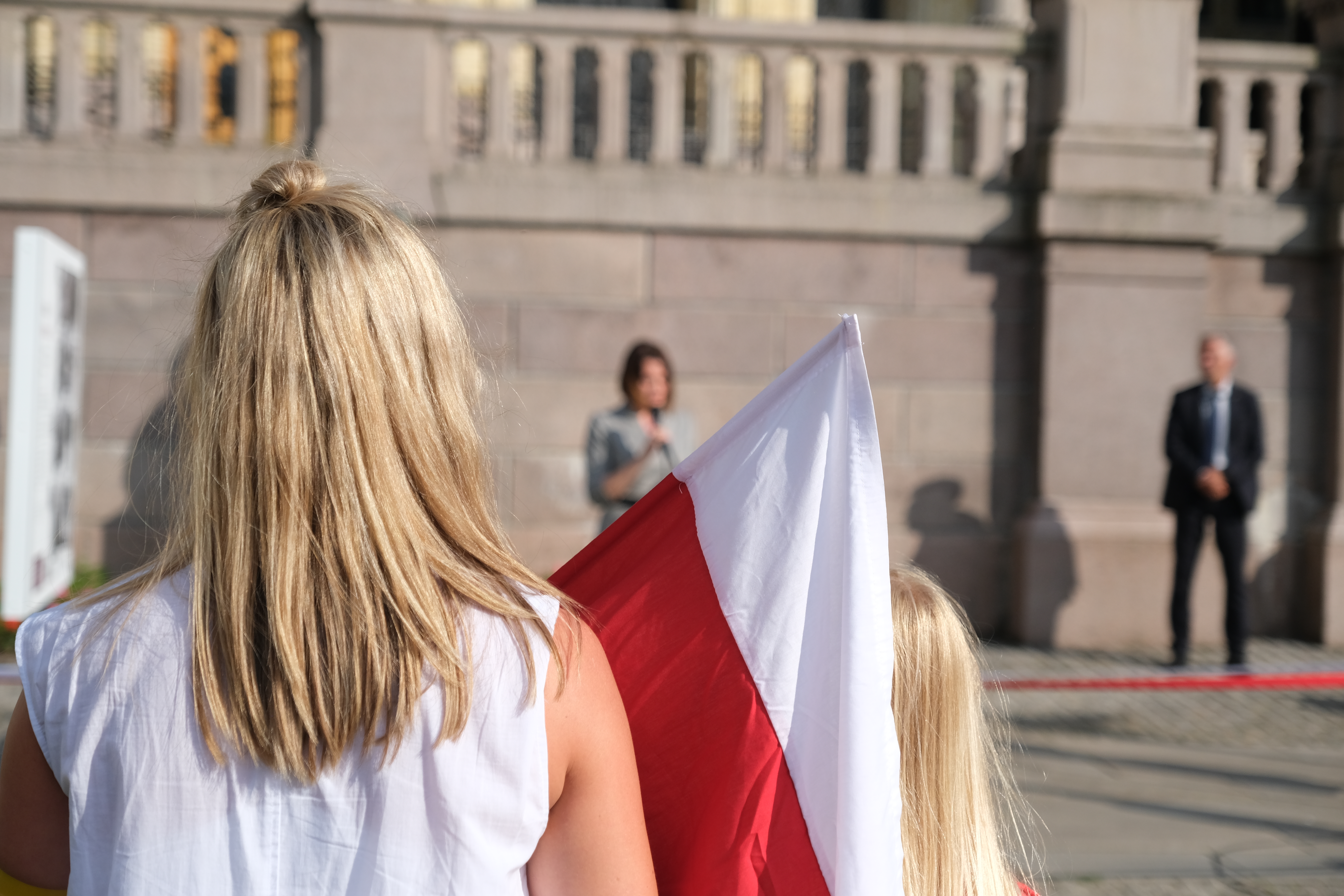
In August, opposition leader, and the real president of Belarus, Svetlana Tikhanouskaya visited Oslo upon the invitation from Norway’s Minister of Foreign Affairs. NHC hosted an NGO meeting for her and joined her at an emotional demonstration demanding freedom for Belarus outside of the Norwegian Parliament.
Norwegian fertilizer company Yara’s kalium-contract with Belaruskali, closely connected to Lukashenko, brought the issue of boycott and sanctions to attention. While Belaruskali at that point was not on the list of companies sanctioned by any state, the calls to Yara to withdraw from their contracts and leave Belarus were loud, both from inside Belarus, and abroad. The case also demonstrated that for Yara, it is not a simple decision to make. Independent local trade unions feared even harder repercussions against its members if Yara left the country, and the negative effects on the regime was not well documented. For these reasons NHC chose to advise Yara to stay. The case also showed that some corporations have gone a long way in understanding and accepting their social responsibility, compared to only a few years ago.
Central Asia
In Central Asia, the efforts to support civil society organisations continued with project support and small grants programs in most of the countries in the region. NHC has a unique position in Central Asia as one of few international human rights organisations with long term presence here. In April 2021, unrest and violence erupted in the border area between Kyrgyzstan and Tajikistan. In total, at least 55 people were killed as a result of the clashes. Throughout 2021, NHC partner Kylym Shamy recorded violations taking place during the conflict and documented 134 instances of civilian houses being burned down or destroyed. As part of the documentation work, Kylym Shamy in cooperation with the NHC’s Center for International Justice carried out a pilot project, utilizing satellite imagery to corroborate findings on the ground.
Conflicts in South Caucasus
In South Caucasus conflict continues to simmer. The cease-fire brokered in late 2020, ending the short and bloody war between Armenia and Azerbaijan held, but just barely. Azerbaijan took back the control over territories surrounding Nagorno-Karabakh, territories which were lost more than quarter of a century ago, as well as half of the disputed Nagorno-Karabakh. But the conflict is far from over, and even with Russian peacekeepers in place skirmishes erupted from time to time. Neither Armenia nor Azerbaijan is happy about their current positions, and the lack of independent investigation of alleged war crimes during the war keeps the conflict heated by mutual accusations of war crimes. The situation reflects on civil society, who have focused notably on conflict-related issues during the past year.
One of our most important victories last year was during our European Football Championship campaign, when we among several others featured an imprisoned wrestler, Said Bakuvi, in jail for political reasons. The social media posts quickly went viral, and before the finals were played the wrestler was freed. Bakuvi wrote to us, after his release:
- Thank you, NHC for your valuable efforts in my release from jail! Your campaign is a strong signal of moral support to the freedom fighters, political prisoners, who pay a very high price of freedom. I perceive this campaign as a sign of solidarity from the entire democratic world with the people of Azerbaijan.
The threat to civil society
Returning to our optimistic start of the year, and rather gloom picture painted of the human rights situation for the population in the Russian Federation, in Belarus and elsewhere, why is it that the authorities in these countries crack down so hard on its own population and organised civil society? The answer is many-faceted, but in essence it is about state leaders who fear being challenged, of losing power. Civil society and independent media provide the society with true and important information about what happens in the country, unmasking violence, abuse of power and corruption. That is why it is not acceptable, and leaders like Putin and Lukashenko need to crush it.
In this situation it is more important than ever to continue our support and solidarity with civil society. We have done so for decades and will continue as long as it remains necessary. As it seems, this solidarity will be needed for a long time still. We build relationships with our partners, and we build partnerships between our partners, inside nations, and among nations.